

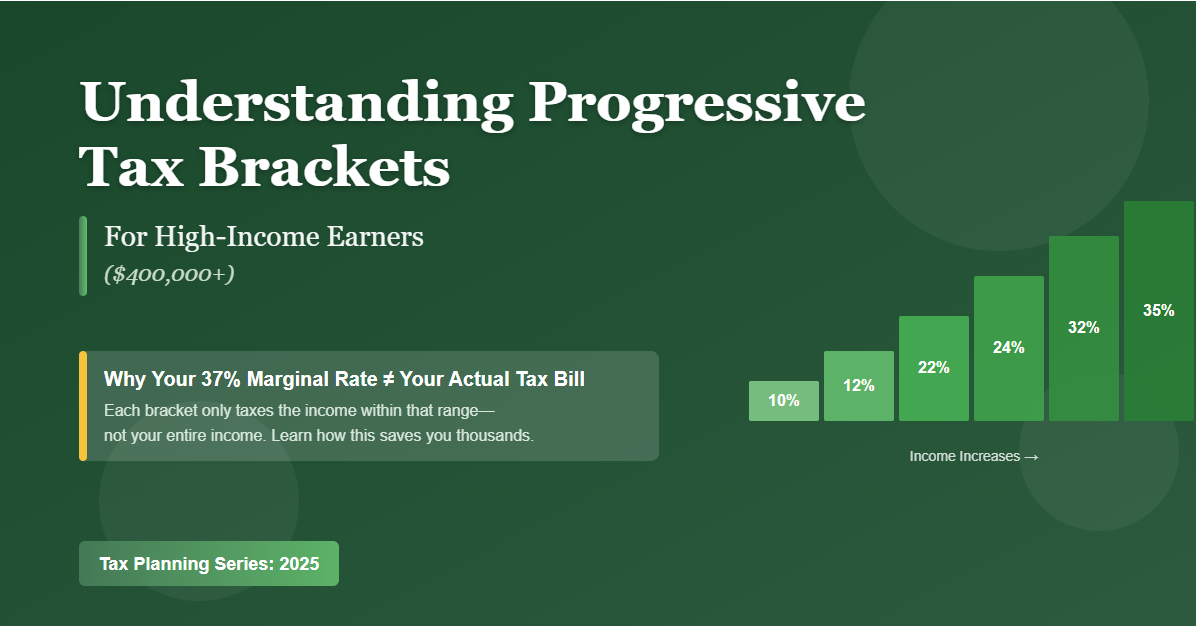
If you’ve recently crossed into the $400,000+ income territory, you may have noticed something: despite hearing you’re in the “37% tax bracket,” your actual tax burden doesn’t feel like you’re handing over 37% of everything you earn. There’s a good reason for that — and understanding this distinction could fundamentally change how you approach tax planning.
This post demystifies one of the most misunderstood aspects of the American tax system: progressive tax brackets. Once you truly grasp how these work, you’ll see why some common fears about earning more money are based on misconceptions — and you’ll be better equipped to make strategic financial moves throughout the year.
The Foundation: What “Progressive” Really Means
The United States uses a progressive tax system built on a straightforward principle: your income isn’t taxed at one flat rate. Instead, imagine your income as water filling a fountain with multiple tiers. Each tier represents a bracket, and only the water that reaches each tier gets taxed at that tier’s rate. The water at the bottom always stays taxed at the lower rate, no matter how full the fountain gets.
This is fundamentally different from what many people instinctively assume. When someone hears they’re “in the 37% bracket,” they often picture their entire income being taxed at 37%. That’s not how it works.
The 2025 Federal Tax Brackets: Your Roadmap
For the 2025 tax year, here’s how the federal income tax brackets are structured for single filers:
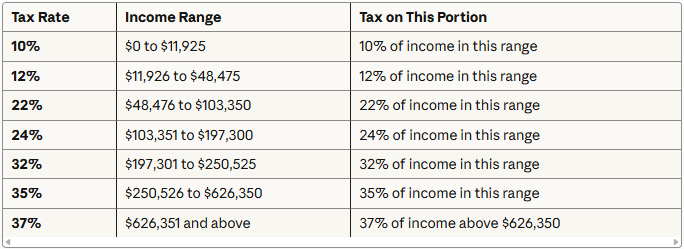
Each bracket applies only to the portion of your income that falls within that range — not your entire income. This is why your effective tax rate will always be lower than your marginal rate.
Key insight: The rates apply to ranges of income, not your total income. This is the critical concept that changes everything.
Marginal vs. Effective Tax Rate: The Distinction That Matters
Two terms that sound similar but mean very different things:
| Term | Definition | When to use it |
|---|---|---|
| Marginal tax rate | The rate you pay on your last dollar earned — the bracket you’ve climbed into | Evaluating incremental income decisions: bonuses, option exercises, timing of deductions |
| Effective tax rate | Your total tax bill divided by your total income — the average rate across all income | Budgeting, understanding your real tax burden, comparing year-over-year |
Think of it like climbing a mountain where different sections have different slopes. Your marginal rate tells you how steep the section you’re currently on is. Your effective rate tells you the average steepness of your entire climb from bottom to top. The average is always gentler than the steepest section, because you had to cross all the easier sections to get there.
A Real-World Example: Meet Sarah
Sarah is a successful tech executive who earned exactly $450,000 in 2025. She’s single with no dependents.
Many people hear that Sarah is “in the 35% tax bracket” and assume she pays $157,500 in taxes (35% of $450,000). Here’s what actually happens:
Sarah’s Income Flowing Through the Brackets
| Bracket | Income in Bracket | Rate | Tax Owed |
|---|---|---|---|
| First $11,925 | $11,925 | 10% | $1,192.50 |
| $11,926 to $48,475 | $36,549 | 12% | $4,385.88 |
| $48,476 to $103,350 | $54,875 | 22% | $12,072.50 |
| $103,351 to $197,300 | $93,950 | 24% | $22,548.00 |
| $197,301 to $250,525 | $53,225 | 32% | $17,032.00 |
| $250,526 to $450,000 | $199,475 | 35% | $69,816.25 |
| Total | $450,000 | $127,047.13 |
Sarah’s marginal tax rate: 35%
Sarah’s effective tax rate: $127,047 / $450,000 = 28.23%
The difference: Nearly 7 percentage points — or over $30,000 — compared to what someone who assumes she pays 35% on everything would expect.
Visualizing the Progressive Nature
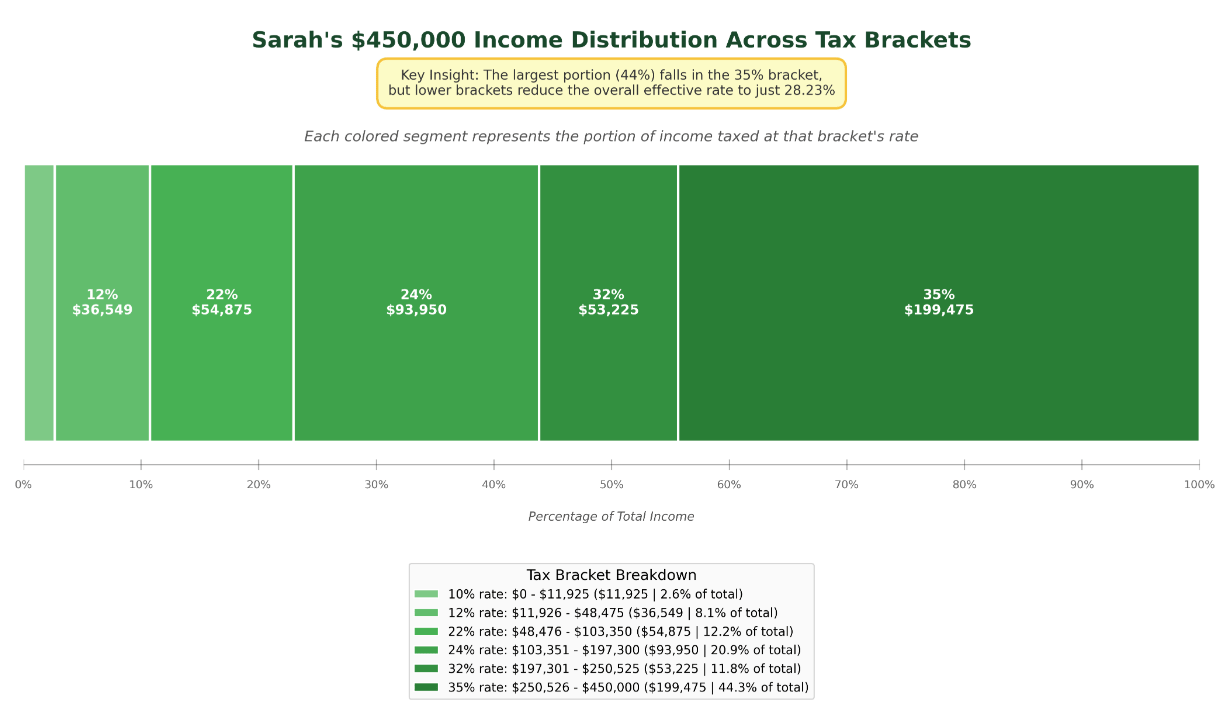
- The first $11,925 (2.65% of her income) is taxed at 10%
- The next $36,549 (8.12% of her income) is taxed at 12%
- The next $54,875 (12.19% of her income) is taxed at 22%
- The next $93,950 (20.88% of her income) is taxed at 24%
- The next $53,225 (11.83% of her income) is taxed at 32%
- The last $199,475 (44.33% of her income) is taxed at 35%
The largest portion of Sarah’s income falls in the 35% bracket — but all the lower brackets contribute to a meaningfully lower effective rate.
Marginal vs. Effective Rate Across Income Levels
The pattern holds at every income level. As you earn more, your effective rate increases — but it never catches up to your marginal rate, because you always benefit from those lower brackets at the bottom:
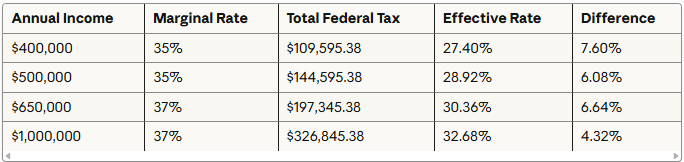
Notice: even at $1,000,000 in income, the effective rate is approximately 33% — not 37%. The gap between marginal and effective rates remains significant at every income level.
3 Misconceptions That Cost High Earners
Misconception 1: “If I earn more and jump to a higher bracket, I’ll take home less money”
This is the most damaging myth in tax understanding. Because only the income that falls into the higher bracket gets taxed at the higher rate, you will always take home more money by earning more.
Example: You’re earning $250,000 and receive a $10,000 bonus that pushes you into the next bracket. That $10,000 is taxed at 35%, so you pay $3,500 on it. You still take home $6,500 more than if you hadn’t earned it. You are better off, not worse off.
Misconception 2: “High earners pay taxes on everything at the top rate”
As Sarah’s example shows, this is not true. Even someone earning $10,000,000 pays 10% on their first $11,925. The progressive structure never disappears, regardless of how high income climbs.
Misconception 3: “My effective rate is close to my marginal rate”
Many high earners are surprised to learn their effective rate is several percentage points lower than their marginal rate. This gap represents real money — potentially tens of thousands of dollars — that you’re keeping rather than paying in taxes.
Strategic Implications for Financial Planning
When your marginal rate matters most
Focus on your marginal rate when making decisions about incremental income or deductions:
- Traditional 401(k) contributions: every dollar contributed saves you taxes at your marginal rate. In the 35% bracket, a $1 contribution saves $0.35 in federal taxes.
- Stock option exercises: timing a $100,000 exercise at $240,000 of income versus $260,000 of income could mean the difference between paying mostly 32% vs. mostly 35% on those gains.
- Roth conversion sizing: knowing your marginal rate tells you the exact cost of converting each additional dollar.
When your effective rate tells the real story
Use your effective rate for overall tax burden and lifestyle planning:
- Budgeting: if your effective rate is 28%, roughly 28 cents of every dollar earned goes to federal income taxes on average.
- Evaluating job offers: a move from $400,000 to $500,000 raises your effective rate from approximately 27.4% to 28.9% — a meaningful increase, but not the 35% hit the marginal rate might suggest.
- Year-over-year comparison: effective rate is the right metric for tracking whether your tax burden is growing faster or slower than your income.
Beyond Federal Income Tax: The Complete Picture
Federal income tax is only part of the story. High earners need to layer in:
| Tax | Rate | Notes |
|---|---|---|
| State income tax | 0% to 13%+ | Ranges from $0 (TX, FL, WA) to 13%+ (CA); many states have their own progressive structures |
| Additional Medicare Tax | 0.9% | Applies to earned income above $200,000 (single filers) |
| Net Investment Income Tax (NIIT) | 3.8% | Applies to investment income above certain thresholds |
| Social Security tax | 6.2% | Caps at the wage base limit — $176,100 for 2025 — so becomes less significant as a percentage at higher incomes |
High earners in high-tax states (e.g., California) may face combined marginal rates approaching or exceeding 50%. Even so, the core principle holds: your effective rate across all these taxes will still be lower than your marginal rate because of the progressive structure.
The Takeaway
Understanding progressive taxation transforms how you think about earning, saving, and planning. The key points:
- Climbing into a higher bracket only affects the income that falls into that bracket — not your entire income.
- Your effective rate (what you actually pay on average) is always meaningfully lower than your marginal rate.
- For a $450,000 earner, the difference between confusing marginal and effective rates means misunderstanding your tax bill by $40,000+.
- Marginal rate drives incremental decisions. Effective rate drives overall planning.
As this series continues, we’ll build on this foundation to explore specific strategies for minimizing your tax burden legally and ethically. But it all starts here — with a clear understanding of how the system actually works.
This post is provided for educational and informational purposes only and does not constitute tax, financial, or legal advice. Tax laws are complex, subject to change, and vary significantly based on individual circumstances. The examples and calculations presented are simplified illustrations. The 2025 tax brackets used are based on inflation-adjusted projections — always verify current figures with official IRS publications or a qualified tax professional. Consult with a qualified tax professional, CPA, enrolled agent, or tax attorney before implementing any tax strategies or making significant financial decisions based on this content.